
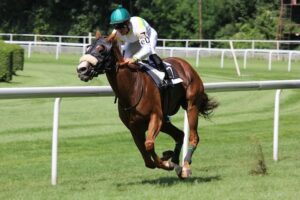
 The Triple Crown Series is a title made of three horse racing events. The Kentucky Derby, Preakness Stakes, and Belmont Stakes are the trio that makes up the Triple Crown Series. Most jockeys and trainers would consider this to be their ultimate goal.
Since its inception, the Triple Crown Series has proved to be the most difficult feat every three-year-old thoroughbred could complete in horse racing. Since the title was first awarded in 1950, just 13 horses have competed in all three races and come out on top.
Opens to only three-year-old thoroughbred horses in America and even abroad, coming together in these three prestigious races. Local horse breeders and trainers all around the world look forward to being part of the races. The endurance of elite three-year-old thoroughbred horses being tested in this field makes the triple crown series a must-attend racing event for racegoers around the world.
That being said, we’re learning about the tradition and short history of the three races that made up the Triple Crown Series; the Kentucky Derby, Preakness Stakes, and the Belmont Stakes. And more importantly, why all three are must-visit events for many racing fans.
#1 – The Kentucky Derby otherwise known as the “Run for the Roses”
The Kentucky Derby dubbed “Run for the Roses”, happens annually on every first Saturday in the month of May, held in Louisville, Kentucky, and is the first event of the Triple Crown Series. Its first ceremonial race kicked off at the same time as today on May 17, 1875. The Kentucky Derby’s official racing distance for its event is approximately 1 1/4 miles comprising 10 furlongs. Considered to be the ultimate test of endurance, the derby which is also dubbed the “most exciting two minutes in sports’ is reportedly the longest-running sports event in the United States of America.
Short History of the Kentucky Derby
Held first in 1875, the Kentucky Derby was founded by Col. Meriwether Lewis Clark Jr who also founded the Louisville Jockey Club. The construction of the Churchill Downs Racetrack was also initiated by him in 1937. The Kentucky Derby’s first winner was Astride.
The colt at the racecourse was built by jockey Oliver Lewis who was trained by Ansel Williamson. Secretariat’s record as the fastest horse to “Run for the Roses”, finishing the race in 1:59.4 minutes, remains untouched.
The Kentucky Derby returns for its 149th year of racing in the coming month of May. To get a hint of horses lined up in a bid to overthrow the Secretariat’s long-standing record as the fastest horse to “Run for the Roses”, Bet on the Kentucky Derby has all the news, details and horse ranking on their website.
The Kentucky Derby Racing Traditions
In addition to long-standing customs that many viewers adore about this event, the Kentucky Derby features the fastest three-year-old thoroughbreds of their age. Every year, there’s a record of 120,000 Mint Juleps to be served at the Run for the Roses event at Churchill Downs, making it the race’s official cocktail. The names of the Kentucky Derby past-winners are printed on the special glass in which these mint juleps are served. It can be taken home by guests as a memento of the occasion.
The Kentucky Derby is attended by well-dressed racegoers in addition to mint juleps. Female visitors are urged to wear their best cocktail dresses and colourful hats, however, there is no official dress code. Men should likewise dress professionally by donning their formal suits, trousers and a pair of loose-fitting shoes.
#2 – The Preakness Stakes
Preakness Stake’s official venue is located at the Pimlico Race Course, Baltimore Maryland. Much like the Kentucky Derby, the Preakness Stake also features three-year-old thoroughbred horses that would race over a distance of 1 3/16 miles or 9.5 furlongs. Two weeks after the Kentucky Derby ends, this event is traditionally held.
Short History of the Preakness Stakes
A look at the Preakness Stakes history shows the first event was held on May 27. 1873. The event was named after a colt Preakness, who won the Dinner Party Stakes racing event held at the Pimlico for the first time on October 25, 1870, by former Maryland Governor Oden Bowie. The Preakness Stakes, however, was first won by Survivor, who bagged a $2,050 USD winning prize for the race.
According to the viewership ratings, the Preakness Stakes, after the Kentucky Derby, is the second most-viewed horse racing event in the whole of North America.
Preakness Stakes Traditions
There’s not much happening at the Preakness Stakes in terms of tradition other than its long-standing singing of Maryland’s official state song, “Maryland, My Maryland.” While the song is being sung, spectators are encouraged to sing aloud the song’s third stanza bringing the utmost feeling to everyone at the venue. Second is the painting of the winning horse and his jockey in a weather vane of an event infield in the colours of the victorious owner’s silks.
#3 – The Belmont Stakes dubbed “Test of the Champion”
The Belmont Stakes being the longest among the three races in the Triple Crown Series got his name as the “Test of the Champion”. Belmont Stakes is raced at an official racing distance of 1 1/2 miles or 12 furlongs. That’s one hell of course!
The Belmont Stakes is held every year on every second Saturday of June at Belmont Park, Elmont, New York, United States. The first inaugural horse racing at the Belmont Stake came into effect on June 18, 1867.
Short History of the Belmont Stakes
The first Belmont Stakes was sponsored by August Belmont Sr. and held at Jerome Park Racecourse in the Bronx. The first Belmont Stakes was won by a female horse that goes by the name Ruthless.
Sir Barton’s victory in the Belmont Stakes in 1919, following victories in the Kentucky Derby and Preakness Stakes, marked the beginning of the Triple Crown Series. The August Belmont Trophy, which would be given to the winning thoroughbred the following year, was first awarded to the race’s victor in 1926. The winner will receive a silver miniature to keep forever.
Belmont Stakes Traditions
The winner of each race will receive a blanket covered in white carnations. In this way, the event came to be known as “The Run for the Carnations.” “The Sidewalks of New York” is the Belmont Stakes’ opening post-parade song.
From 1997 through 2009, Frank Sinatra’s Theme from New York, New York was used in its place. The following year, it was modified to Jasmine V’s Empire State of Mind. In 2011, a Theme from New York, New York was once again used as the post-parade song.
Conclusion
Every one of the three races herein is crucial to American history. These races serve as a stage for promising thoroughbreds to display their perseverance and vigour as three-year-olds in addition to bringing the horseracing community closer together. The Triple Crown Series has been the goal for these hopefuls, who can only enter these races once.
In international football, it is much less common to see a less-vaunted team pick up a win over a favoured contender. International teams play just a few games every year, and when those games are competitive as opposed to friendlies, they bring their full concentration to it. While club football needs a full-season shock to really grab the attention, an international team losing to a minnow is a big deal. They can call on players from the best clubs in the world; their opponents can scratch together any eleven people with boots and a passport. And that’s why international football shocks, when they come, are talked about for decades afterwards.
North Korea 1 Italy 0, 1966
After early defeats, both teams came into this game needing a win to reach the quarter-finals. The expectation was that Italy would more or less match the 3-0 blanking that the USSR had inflicted on the North Korean side. Instead, the player fastened on to a loose ball outside the Italian penalty area just before half-time. He unleashed a shot which flew into the Italian net, and despite intense second-half pressure, that would be the game’s only goal. On returning home, the eliminated Italian squad was pelted with rotten tomatoes. North Korea for their part took a 3-0 lead in the next round against Portugal, but a dream trip to the semis was denied by a second-half Eusebio-inspired comeback and a 5-3 defeat.
Ireland 1 England 0, 1988
Ireland have played – and beaten – better teams than the 1988 version of England, but in 1988 they entered the Euros as rank outsiders, the weakest of the eight teams taking part. The goal that sealed the game came in the sixth minute, and wasn’t the best you’ll ever see. Irish attackers couldn’t get a clean cross in, but English defenders couldn’t fashion a clearance and as the ball ballooned into the Stuttgart air Ray Houghton, then of Liverpool, met it with a looping header. Peter Shilton was beaten and so, 84 minutes later, were England. Jack Charlton, a former World Cup winner with England, became an Irish national hero for masterminding the upset victory, and the story was only beginning.
Saudi Arabia 2 Argentina 1, 2022
Lionel Scaloni’s side came into the tournament as one of the favourites, and an early Leo Messi penalty seemed to herald a comfortable entry to the 2022 World Cup. As the first half went on, an unusually profligate Argentina failed to add to their lead, and they paid for it within the first ten minutes of the second half. First Saleh Al Shehri fired in an equaliser, and then a stunning curling strike from Salem Al Dawsari in the 53rd minute put the Saudis 2-1 up. Even with the 2022 World Cup’s fashion for adding on huge swathes of time after the 90 minutes had elapsed, Argentina could not find an equaliser. Still, all’s well that ends well.
 The oldest race run at the Cheltenham Festival is Grand Annual Challenge Cup Handicap Chase or, more correctly, the Johnny Henderson Grand Annual Challenge Cup Handicap Chase, as the race has been known since 2005.
The late Major John ‘Johnny’ Henderson, father of leading National Hunt trainer Nicky Henderson, was an influential figure in the horseracing world. In 1963, he brought together a group of investors to buy Cheltenham racecourse for £240,000, thereby preventing it from being taken over by property developers. The following year, he was instrumental in the formation of Racecourse Holdings Trust (now Jockey Club Racecourses). Henderson Snr. died in December, 2003, aged 83 and, two years later, his name was added to the race title in recognition of his contribution to safeguarding Cheltenham.
Nowadays, the Johnny Henderson Grand Annual Challenge Cup Handicap Chase is run over a distance of about 2 miles, or 1 mile, 7 fulongs and 199 yards to be precise, on the New Course at Cheltenham on the second day of the Cheltenham Festival. However, the inaugural Grand Annual Chase was run on April 4, 1834 – five years before the first ‘official’ running of the Grand National –
in the vicinity of Andoversford, east of Cheltenham. Thus, the Grand Annual Chase is not only the oldest race run at the Cheltenham Festival, but also the oldest surviving race in the British National Hunt calendar.
The Grand Annual Chase was run over various courses and distances – in 1835, for example, a distance ‘upwards of four miles’ – in the locality until 1843 and, after a four-year hiatus, was transferred to Noverton, adjoining Prestbury Park. Between 1861 and 1866, the race was run at Southam, Warwickshire and, thereafter, not run at all until the early twentieth century; it finally returned, permanently, to Cheltenham in 1913.
For the uninitiated, and those taking a break from jokacasino real money online casino, the FIFA World Cup match which became known as the ‘Battle of Berne’ was the quarter-final between Hungary, a.k.a. the ‘Mighty Magyars’, and Brazil, played at the Wankdorf Stadium in Berne, Switzerland on June 27, 1954. History records that Hungary won the match 4-2, before beating Uruguay 4-2, after extra time, in the semi-final and losing 3-2 to West Germany in the final.
However, the final scoreline was no reflection of the quality of the play on the field during what was, arguably, the most eventful 90 minutes. In a match played in treacherous, rainy conditions, Hungary took an early 2-0 lead, courtesy of goals from strikers Nándor Hidegkuti and Sándor Kocsis, before Brazilian right-back Djalma Santos pulled a goal back, from the penalty spot, after 18 minutes.
The scoreline remained 2-1 until half-time but, when Hungary were awarded a penalty, scored by left-back Mihály Lantos, after an hour, all hell broke lose. The Brazilian entourage invaded the pitch and, thereafter, the match descended into a free-for-all, with cynical, professional fouls and violent conduct very much the order of the day. Brazilian striker pulled another goal back after 65 minutes but, six minutes later, Hungarian midfielder József Bozsik and Brazilian left-back Nilton Santos came to blows after a foul by the latter and both were sent off. Brazilian striker was also dismissed for violent conduct after 71 minutes.
Kocsis scored his second goal of the game after 88 minutes to seal a 4-2 victory for Hungary but, by that stage, the final score was almost immaterial. After the final whistle, the violence continued, on the pitch, in the tunnel and even in the dressing rooms but, remarkably, FIFA took no disciplinary action against either country.
The man charged with maintaining order on that fateful day was Yorkshire-born Arthur Ellis. He would later become a familiar face on the BBC television game show ‘It’s A Knockout’ but, at that time, was one of the most famous referees in England. Having awarded 42 free kicks and two penalties, and issued four cautions and three dismissals, Ellis said, ‘Whether politics and religion had something to do with it I don’t know, but they behaved like animals. It was a disgrace. It was a horrible match….My only thought was that I was determined to finish it.’